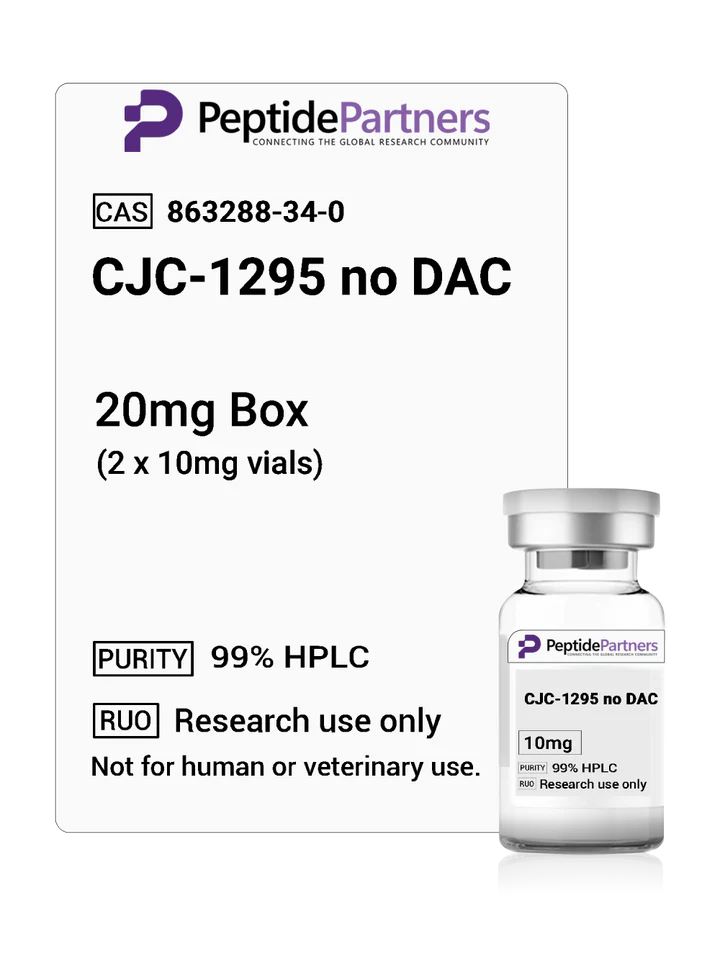
CJC-1295 no DAC (10mg vials)
Price range: $117.00 through $888.00
-
Research peptide: CJC-1295 no DAC Kit, a growth hormone-releasing hormone (GHRH) analogue for laboratory research.
-
Primary research target: Growth hormone-releasing factor receptor (GHRH receptor).
-
Format: 10 mg vials with 3 mL vial capacity.
-
Available box combinations: 20 mg, 50 mg, 100 mg, and 200 mg.
-
Purity: 99.77% multi-vial purity.
-
Testing status: Doubly validated and independently tested; purity, endotoxin, and heavy-metals screenings passed.
-
Batch details: Manufacturer ID WF03; batch CJ202606.
-
Research focus: GHRH analogue detection, peptide metabolism, mass-spectrometry methods, receptor activity, and preclinical endocrinology research.
- Independent certificate details, manufacturer IDs, and batch IDs should be reviewed before purchase when available.
- Order cancellations for full refunds are available before shipment; shipped orders cannot be cancelled or refunded.
- For damaged or incorrect goods, photograph the outer packaging, inner packaging, and product labels, then email support within 48 hours of carrier delivery.
Buy CJC-1295 no DAC Kit – Peptide Partners
Product Overview & Specifications
CJC-1295 no DAC is a synthetic growth hormone-releasing hormone (GHRH) analogue supplied by Peptide Partners for in-vitro testing, laboratory experimentation, analytical research, and preclinical endocrinology studies.
Research involving CJC-1295 and related GHRH analogues has examined GHRH-receptor activity, peptide stability, albumin bioconjugation, growth-hormone secretion assays, urinary detection, and in-vitro metabolism. The available literature includes analytical methods designed to identify GHRH analogues and their metabolites, as well as cellular and animal experiments investigating modified GHRH constructs.
Results from laboratory and animal models should not be interpreted as evidence of human safety, clinical efficacy, or suitability for administration. Researchers should confirm the exact analogue configuration, batch documentation, and certificate of analysis before beginning any experiment.
Product Specifications
| Specification | Details |
|---|---|
| Product name | CJC-1295 no DAC Kit |
| Compound type | Synthetic GHRH analogue research peptide |
| Primary research target | Growth hormone-releasing hormone receptor (GHRH receptor) |
| Product format | 10 mg vials |
| Vial size | 10 mg |
| Vial capacity | 3 mL |
| Available box combinations | 20 mg, 50 mg, 100 mg, and 200 mg |
| Multi-vial purity | 99.77% |
| Validation | Doubly validated |
| Independent testing | Yes |
| Endotoxin screening | Passed |
| Heavy-metals screening | Passed |
| Purity screening | Passed |
| Manufacturer ID | WF03 |
| Batch ID | CJ202606 |
| Cost per milligram | $4.44–$5.85 |
The stated 99.77% purity is based on multi-vial testing. Researchers should review the applicable batch documentation and certificate of analysis before beginning any experiment.
Primary Research Studies & Findings
An Antibody-Free, Ultrafiltration-Based Assay for the Detection of Growth Hormone-Releasing Hormones in Urine at Low pg/mL Concentrations Using nanoLC-HRMS/MS
Authors: Gilles Coppieters, Koen Deventer, Michaël Polet, Peter Van Eenoo, and Péter Judák
Publication source: Journal of Pharmaceutical and Biomedical Analysis, 2022;214
Reference: View publication
This study developed and validated an antibody-free analytical method for screening and confirming GHRH analogues, including CJC-1295, in urine. The method used ultrafiltration to concentrate samples, followed by nano-liquid chromatography and high-resolution tandem mass spectrometry (nanoLC-HRMS/MS).
The reported method achieved low picogram-per-millilitre detection capability and was evaluated for screening and confirmatory analysis. The researchers reported recoveries ranging from 59% to 115% and noted that the approach could be adapted to emerging peptide analogues and metabolites for which suitable antibodies are unavailable.
The study also identified sample-handling considerations, including the importance of temperature and pH control because certain GHRH analogues and metabolites can degrade during storage or processing.
Plain-English Research Summary
This research focused on how laboratories can detect very small amounts of CJC-1295 and related GHRH analogues in urine. The method uses filtration and high-resolution mass spectrometry rather than antibody-based purification. It is relevant to analytical chemistry, peptide detection, and laboratory monitoring—not to product administration or performance enhancement.
Advances in the Detection of Growth Hormone-Releasing Hormone Synthetic Analogs
Authors: Siham Memdouh, Ivana Gavrilović, Kelsey Ng, David Cowan, and Vincenzo Abbate
Reference: View publication
This study investigated the in-vitro metabolism of several large synthetic GHRH analogues, including CJC-1295, in fortified human urine. The researchers characterized major peptide metabolites and developed a liquid chromatography–tandem mass spectrometry (LC-MS/MS) method for their detection.
The reported work identified nineteen major in-vitro metabolites that were synthesized, purified, and characterized. The analytical method achieved limits of detection at or below 1 ng/mL under the tested conditions, providing a framework for identifying parent compounds and metabolism products in laboratory samples.
Plain-English Research Summary
This study examined how CJC-1295 and related synthetic GHRH analogues can break down in urine under laboratory conditions. The researchers identified resulting peptide fragments and used them to improve mass-spectrometry detection. The findings are relevant to analytical and metabolism research and do not provide a dosing, safety, or therapeutic protocol.
Human Growth Hormone-Releasing Factor (hGRF)1–29-Albumin Bioconjugates Activate the GRF Receptor on the Anterior Pituitary in Rats: Identification of CJC-1295 as a Long-Lasting GRF Analog
Authors: Lucie Jetté, Roger Léger, Karen Thibaudeau, Corinne Benquet, Martin Robitaille, Isabelle Pellerin, Véronique Paradis, Pieter van Wyk, Khan Pham, and Dominique P. Bridon
Publication: Endocrinology, 2005;146(7):3052–3058
DOI: 10.1210/en.2004-1286
Reference: View publication
This study evaluated three modified human growth hormone-releasing factor 1–29 derivatives, including CJC-1295. The researchers examined in-vitro stability against dipeptidylpeptidase-IV (DPP-IV), activity in cultured rat anterior pituitary cells, acute growth-hormone secretion in rats, and plasma persistence after administration in the animal model.
Albumin-conjugated derivatives showed greater in-vitro stability against DPP-IV than the unmodified hGRF 1–29 peptide. In cultured rat pituitary cells, the conjugates retained activity in growth-hormone secretion assays. In rats, the CJC-1295 construct was detected in plasma beyond 72 hours and was associated with an extended plasma residence time compared with the unmodified reference peptide.
The study examined a CJC-1295 derivative containing a reactive maleimide group designed to form an albumin conjugate. Researchers should distinguish that experimental construct from any specific commercial “no DAC” formulation, as the study material and the supplied product may not be identical.
Plain-English Research Summary
This study examined how modified GHRH peptides behave in laboratory assays and rats. The researchers found that the tested CJC-1295 derivative could remain more stable and persist longer in the animal model after albumin binding. The findings are formulation-specific and preclinical; they do not establish that a CJC-1295 no-DAC product has the same properties or is suitable for human use.
Standard Research Disclaimer
Research Use Only. Not for use in diagnostic tests.
This product is solely intended for research purposes as a chemical compound. It is designated exclusively for in-vitro testing and laboratory experimentation. All information provided about this product is educational and should be evaluated by appropriately qualified research personnel.
By law, bodily introduction of this product into humans or animals is strictly prohibited. This compound must not be used, administered, or represented as a drug, food, dietary supplement, cosmetic, diagnostic material, performance-enhancing substance, or medical treatment. It is not intended to diagnose, treat, cure, or prevent any disease. It should be handled only by licensed and qualified professionals in an appropriately equipped laboratory and in accordance with applicable laws, institutional procedures, and relevant safety requirements.
| Choose pack |
2 vials × 10mg (20mg total) ,5 vials × 10mg (50mg total) ,10 vials × 10mg (100mg total) ,20 vials × 10mg (200mg total) |
|---|
- All of our manufacturing partners produce peptides using the Lyophilization (Freeze Drying) process, ensuring products maintain stability for shipping and storage for 12+ months.
- In lyophilized form, they are shelf-stable for many weeks. However, for long-term storage, it is recommended to store them in the freezer.
- We often hear concerns about the standard "discard after 28 days of first use" disclaimer. Don't worry, this has nothing to do with studies regarding the efficacy of specific peptides. 28 days is the FDA requirement for producers of multi-use vials to prove their bacteriostatic maintains efficacy. This minimum requirement becomes the de facto standard.
- In our experience, if you use proper sterile procedures and refrigerated storage, you can continue sampling from the same reconstituted vial for 3+ months.
Certificate records
No published certificate records are available for this product.
Search Certificate LedgerRelated products
DSIP (5mg vials)
Price range: $75.00 through $305.00
Humanin (10mg vials)
Price range: $165.00 through $720.00